NASA’s Webb Telescope Shares Deepest Infrared Image Of The Early Universe
NASA's Webb telescope shares deepest infrared image of the early universe. The SMACS 0723 galaxy cluster, which is Webb's first deep field, contains hundreds of galaxies, some of the weakest objects ever seen in the infrared. Compared to the vastness of space, Webb's picture is about the size of a grain of sand held at arm's length. This cluster of galaxies is so massive that it functions as a gravitational lens, magnifying distant galaxies, including those from the early universe.
Author:Suleman ShahReviewer:Han JuOct 27, 2022
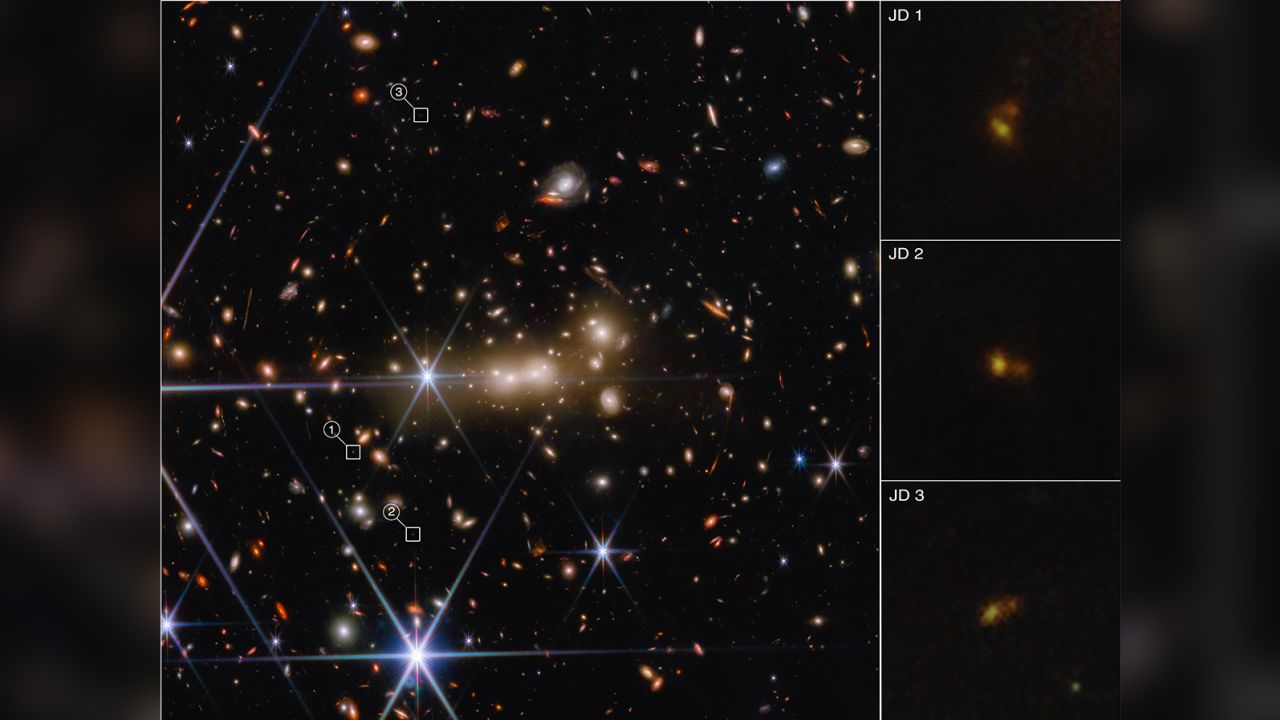
NASA's Webb telescope shares deepest infrared image of the early universe. The SMACS 0723 galaxy cluster, which is Webb's first deep field, contains hundreds of galaxies, some of the weakest objects ever seen in the infrared.
Compared to the vastness of space, Webb's picture is about the size of a grain of sand held at arm's length. This cluster of galaxies is so massive that it functions as a gravitational lens, magnifying distant galaxies, including those from the early universe.
Composited over 12.5 hours using Webb's Near-Infrared Camera (NIRCam), this deep field achieves infrared wavelength depths beyond the deepest fields acquired by the Hubble Space Telescope, which required weeks. This is only the first step. Webb will continue to be used by scientists to make longer exposures, allowing us to learn more about the cosmos.
Many additional galaxies can be seen in front of and behind the galaxy cluster SMACS 0723 in this picture, which was taken 4.6 billion years ago. As scientists dive further into Webb's data, much more will become clear about this cluster. The Mid-Infrared Instrument (MIRI) on the Webb Space Telescope took pictures of this part of the infrared spectrum.
Through Webb's NIRCam, previously invisible structures in faraway galaxies, like star clusters and hazy features, have been brought into clear focus.
James Webb Space Telescope
As far as space observatories go, the James Webb Space Telescopeis unrivaled. The Webb Space Telescope will help us better understand our solar system, see out to distant planets orbiting other stars and investigate the origins, architecture, and fate of the cosmos. NASA is the lead agency on the Webb program, including the European Space Agency and the Canadian Space Agency as partners.
The NIRSpec instrument, the MIRI instrument optical bench assembly, the supply of launch services, and the people to support mission operations are the main contributions of ESA to the project. In exchange for their funding, European researchers will get at least 15% of the overall observation time, just as they do with the NASA/ESA Hubble Space Telescope.
How Does Image By Webb Telescope Better Than Hubble?
The cluster allows for a special sort of observational phenomenon that makes the distant galaxy observable. This effect, known as gravitational lensing, happens when galaxies in the foreground serve as magnifying glasses for distant objects in the background.
The galaxy MACS0647-JD was located using tiny boxes, and more in-depth views of it are oriented to the image's right side. The cluster acted as a kind of "triple lens," amplifying and distorting the galaxy such that it appeared in three locations at once. Different aspects of the galaxy are shown in the corresponding boxes on the right.
Using the Hubble Space Telescope, astronomer Dan Coe found MACS0647-JD ten years ago. Two unexpected characteristics of the galaxy were discovered in the latest Webb picture. The Hubble Space Telescope only revealed a dim red dot. "We could see it was incredibly small, just a tiny galaxy in the first 400 million years of the universe," said Coe, an astronomer at the Space Telescope ScienceInstitute for the European Space Agency and the Association of Universities for Research in Astronomy, in a NASA press release.
Now that we have Webb, we can see two distinct things. Both the existence of two separate galaxies and the existence of two separate star clusters inside a single galaxy are under active debate. What we do know is that Webb is supposed to assist us in figuring out why we don't know these things.
The NASA/ESA/CSA James Webb Space Telescope captured this stunning near-infrared image of the Pillars of Creation. The pillars, which resemble spires and arches rising out of a desert, are really packed with gas and dust that seem only partially transparent. Young stars are developing in this area or have just emerged from their dusty embryonic stages.
In this NIRCam picture, the protostars are the real show-stoppers. These are the blazing red orbs with eight diffraction spikes that sometimes show up in the sky. Large enough knots inside the pillars will ultimately collapse under their own weight, heat up, and shine brilliantly. Wavy lines, perhaps lava, run around the pillars' perimeters. Stars in the process of formation are the sources of these outbursts.
Young stars have the potential to interact with surrounding material clouds, such as these voluminous pillars of gas and dust. When this occurs, bow shocks may develop, creating waves similar to those made by a boat on the sea. These infant stars are just a few hundred thousand years old, yet they have millions of years left to continue to mature.
The interstellar medium acts as a drawn curtain that prevents us from seeing what is beyond the pillars, even if near-infrared light makes it seem that we can "penetr through" the backdrop. This is also why you don't see any faraway galaxies in this picture. This thin film of gas obscures our perspective of the distant cosmos. In addition, the "party" of stars that have escaped from the pillars sheds light on the dust, making it easier to see.
It's like trying to see an event outside a party while standing in a brightly lighted room; the reflected light from within the room dims the outside view while enhancing the revelry inside. Thanks to Webb's new view of the Pillars of Creation, scientists can update their models of how stars form. The James Webb Space Telescope has given us new information about the "Pillars of Creation" that we didn't know before.
One of them is bluer, and the other is redder than the other. Variations in gas types are shown by color. The blue object represents the birth of new stars, whereas the red object is dusty and ancient. Two objects in the galaxy picture have astronomers wondering whether two galaxies have merged.
Final Words
Two of Webb's equipment collected spectra in addition to photos, which reveal physical and chemical aspects of objects and will allow astronomers to uncover much more information about distant galaxies in this area. Webb's Near Infrared Spectrograph (NIRSpec) employed a micro shutter array to simultaneously study 48 distinct galaxies, a first in space, and return a comprehensive data set for each.
The research showed that it took light from a single galaxy 13.1 billion years to reach Webb's mirrors. The NIRSpec data also shows how finely resolved the spectra of galaxies will be with the Webb telescope.
Last but not least, the spectra of all the objects in Webb's field of vision were taken simultaneously using Wide-Field Slitless Spectroscopy by the Near-Infrared Imager and Slitless Spectrograph (NIRISS). The findings include evidence that one of the galaxies is really a reflection of another.

Suleman Shah
Author
Suleman Shah is a researcher and freelance writer. As a researcher, he has worked with MNS University of Agriculture, Multan (Pakistan) and Texas A & M University (USA). He regularly writes science articles and blogs for science news website immersse.com and open access publishers OA Publishing London and Scientific Times. He loves to keep himself updated on scientific developments and convert these developments into everyday language to update the readers about the developments in the scientific era. His primary research focus is Plant sciences, and he contributed to this field by publishing his research in scientific journals and presenting his work at many Conferences.
Shah graduated from the University of Agriculture Faisalabad (Pakistan) and started his professional carrier with Jaffer Agro Services and later with the Agriculture Department of the Government of Pakistan. His research interest compelled and attracted him to proceed with his carrier in Plant sciences research. So, he started his Ph.D. in Soil Science at MNS University of Agriculture Multan (Pakistan). Later, he started working as a visiting scholar with Texas A&M University (USA).
Shah’s experience with big Open Excess publishers like Springers, Frontiers, MDPI, etc., testified to his belief in Open Access as a barrier-removing mechanism between researchers and the readers of their research. Shah believes that Open Access is revolutionizing the publication process and benefitting research in all fields.

Han Ju
Reviewer
Hello! I'm Han Ju, the heart behind World Wide Journals. My life is a unique tapestry woven from the threads of news, spirituality, and science, enriched by melodies from my guitar. Raised amidst tales of the ancient and the arcane, I developed a keen eye for the stories that truly matter. Through my work, I seek to bridge the seen with the unseen, marrying the rigor of science with the depth of spirituality.
Each article at World Wide Journals is a piece of this ongoing quest, blending analysis with personal reflection. Whether exploring quantum frontiers or strumming chords under the stars, my aim is to inspire and provoke thought, inviting you into a world where every discovery is a note in the grand symphony of existence.
Welcome aboard this journey of insight and exploration, where curiosity leads and music guides.
Latest Articles
Popular Articles