NASA's Juno Probe Visits Jupiter's Volcanic Moon Io
NASA' Juno probe visits Io, the most volcanically active planet in the Solar System. It has begun an approach sequence in which it will go closer and closer to the target. The spacecraft has already zoomed past the Jupiter moon from a distance of 80,000 kilometers, revealing the moon's terrible, lava-strewn terrain in all its gory glory.
Author:Suleman ShahReviewer:Han JuDec 16, 2022
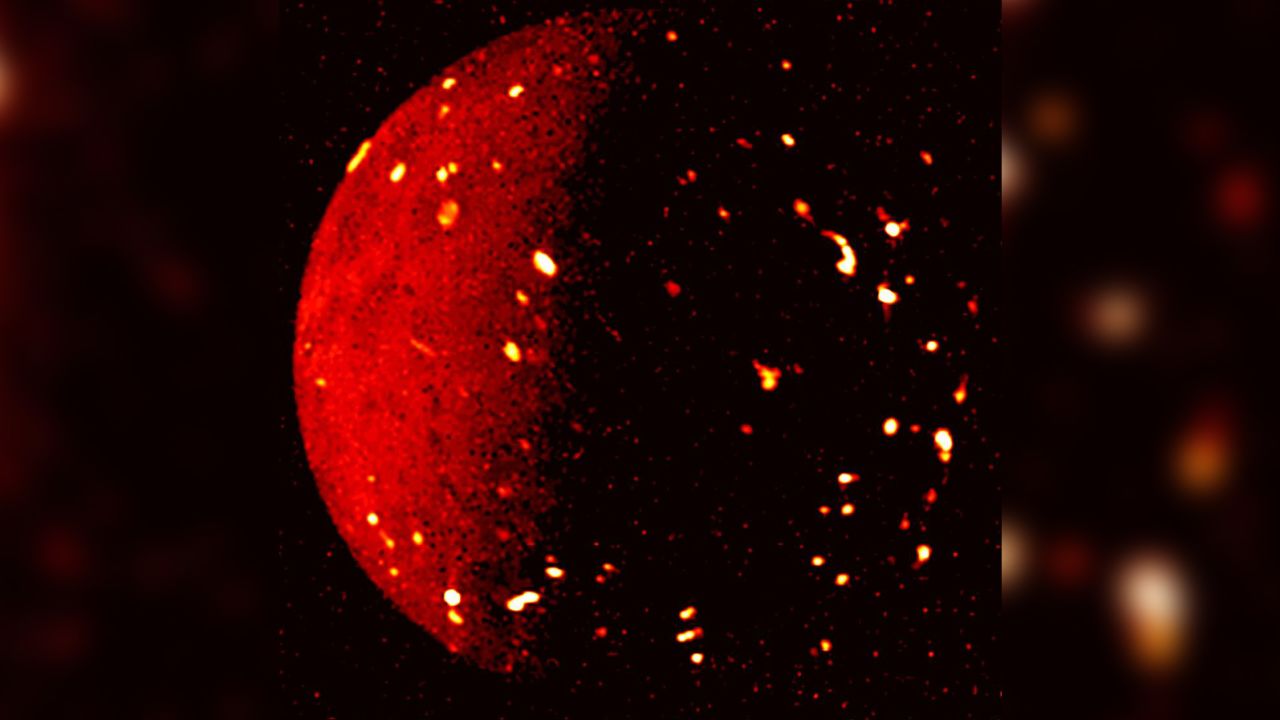
NASA' Juno probe visits Io, the most volcanically active planet in the Solar System. It has begun an approach sequence in which it will go closer and closer to the target.
The spacecraft has already zoomed past the Jupitermoon from a distance of 80,000 kilometers, revealing the moon's terrible, lava-strewn terrain in all its gory glory.
But over the course of the next year, Juno will travel much, much closer to Io, finally sweeping across the surface at an altitude of only 1,500 kilometers. It has been almost 20 years since humanity last came so close to the 3,650 km wide asteroid.
“„We're also going to be looking at the gravity field, trying to understand the interior structure of Io, to see if we can constrain whether the magma that's creating all these volcanoes forms a global ocean, or whether it's spotty. We have a number of objectives besides trying to understand the volcanoes and lava flows, and to map them.- Dr Scott Bolton, Southwest Research Institute

Gravitas: Nasa spacecraft to visit most volcanic world in solar system
Io Most Volcanically Active World In The Solar System
When it comes to moons, Jupiter has an embarrassment of riches. Io, one of its 80 known moons, is described by NASA as the most volcanically active globe in the solar system. Io is poised to take center stage when NASA's Juno mission, which is investigating Jupiter, focuses its cameras and equipment on the scorching moon.
NASA shared a magnificent infrared picture of Io taken by Juno in July from a distance of 50,000 miles in anticipation of obtaining fresh Io images (80,000 kilometers). The greater the temperature, the brighter the hue, thus all those specks reveal how volcanically ecstatic the moon is.
NASA announced on Wednesday that the Juno spacecraft will photograph Io on December 15. We're anticipating some new photographs, but they'll just be a taster before the main meal. Juno will make closer passes to Io in 2023 and 2024.
Jupiter's moon as seen in infrared Io depicts it in red with several brilliant areas suggesting greater temperatures. Juno arrived at Jupiter in 2016 and received a mission extension in 2021 for a series of flybys of Jupiter's most fascinating moons. Io is the most recent to get noticed.
Juno's image library, which includes flybys of the moons Ganymede and Europa, is growing. The spacecraft's close-up pictures revealed how crazy those surfaces are. Europa is especially intriguing since it will be the focal point of NASA's planned Europa Clipper mission. In our solar system, the moon is thought to be a suitable area to seek indications of life.
Io is somewhat bigger than the moon of Earth. It is famous for its molten lava lakes and eruptions. In late 2018, Juno discovered an active volcanic plume. NASA has scheduled nine flybys of Io. There will be more to it than simply nice photographs. Researchers will be examining how Io interacts with Jupiter and how the moon is tied to the gas giant's auroras.
If we're fortunate, we'll be able to observe Io from a different perspective, up close and personal with its volcanic characteristics. We could even get to watch it spout lava. That would be scorching.
Final Words
The first mission, which is scheduled to launch in April 2023, will spend three years researching Jupiter and three of its frozen moons, Ganymede, Callisto, and Europa. Oceans are expected to exist under the ice-covered crusts of all three moons, and scientists want to see whether Ganymede's ocean is possibly livable.
After arriving in 2030, Europa Clipper will launch in 2024 and execute a dedicated series of 50 flybys around the moon. Europa Clipper, which will eventually descend from a height of 1,700 miles (2,736 kilometers) to barely 16 miles (26 kilometers) above the moon's surface, may be able to assist scientists in determining if an inner ocean exists and whether the moon may host life.

Suleman Shah
Author
Suleman Shah is a researcher and freelance writer. As a researcher, he has worked with MNS University of Agriculture, Multan (Pakistan) and Texas A & M University (USA). He regularly writes science articles and blogs for science news website immersse.com and open access publishers OA Publishing London and Scientific Times. He loves to keep himself updated on scientific developments and convert these developments into everyday language to update the readers about the developments in the scientific era. His primary research focus is Plant sciences, and he contributed to this field by publishing his research in scientific journals and presenting his work at many Conferences.
Shah graduated from the University of Agriculture Faisalabad (Pakistan) and started his professional carrier with Jaffer Agro Services and later with the Agriculture Department of the Government of Pakistan. His research interest compelled and attracted him to proceed with his carrier in Plant sciences research. So, he started his Ph.D. in Soil Science at MNS University of Agriculture Multan (Pakistan). Later, he started working as a visiting scholar with Texas A&M University (USA).
Shah’s experience with big Open Excess publishers like Springers, Frontiers, MDPI, etc., testified to his belief in Open Access as a barrier-removing mechanism between researchers and the readers of their research. Shah believes that Open Access is revolutionizing the publication process and benefitting research in all fields.

Han Ju
Reviewer
Hello! I'm Han Ju, the heart behind World Wide Journals. My life is a unique tapestry woven from the threads of news, spirituality, and science, enriched by melodies from my guitar. Raised amidst tales of the ancient and the arcane, I developed a keen eye for the stories that truly matter. Through my work, I seek to bridge the seen with the unseen, marrying the rigor of science with the depth of spirituality.
Each article at World Wide Journals is a piece of this ongoing quest, blending analysis with personal reflection. Whether exploring quantum frontiers or strumming chords under the stars, my aim is to inspire and provoke thought, inviting you into a world where every discovery is a note in the grand symphony of existence.
Welcome aboard this journey of insight and exploration, where curiosity leads and music guides.
Latest Articles
Popular Articles